
Local SEO in the AI era: winning Maps, AI Overviews and ChatGPT at once
How local businesses get found in Google Maps, AI Overviews and ChatGPT in 2026: Google Business Profile, Bing Places, NAP, schema and a clear roadmap – with DACH data.
Short answer: Local SEO in 2026 is no longer a Maps-only game. You still need the same foundations – Google Business Profile, NAP consistency, reviews, local content – plus a second track: citable facts for AI Overviews, Gemini, ChatGPT and Perplexity. Gemini leans heavily on Google Maps data. ChatGPT often pulls local recommendations through Bing Places and the open web. If you only optimise the Local Pack, you stay invisible for a growing share of local questions.
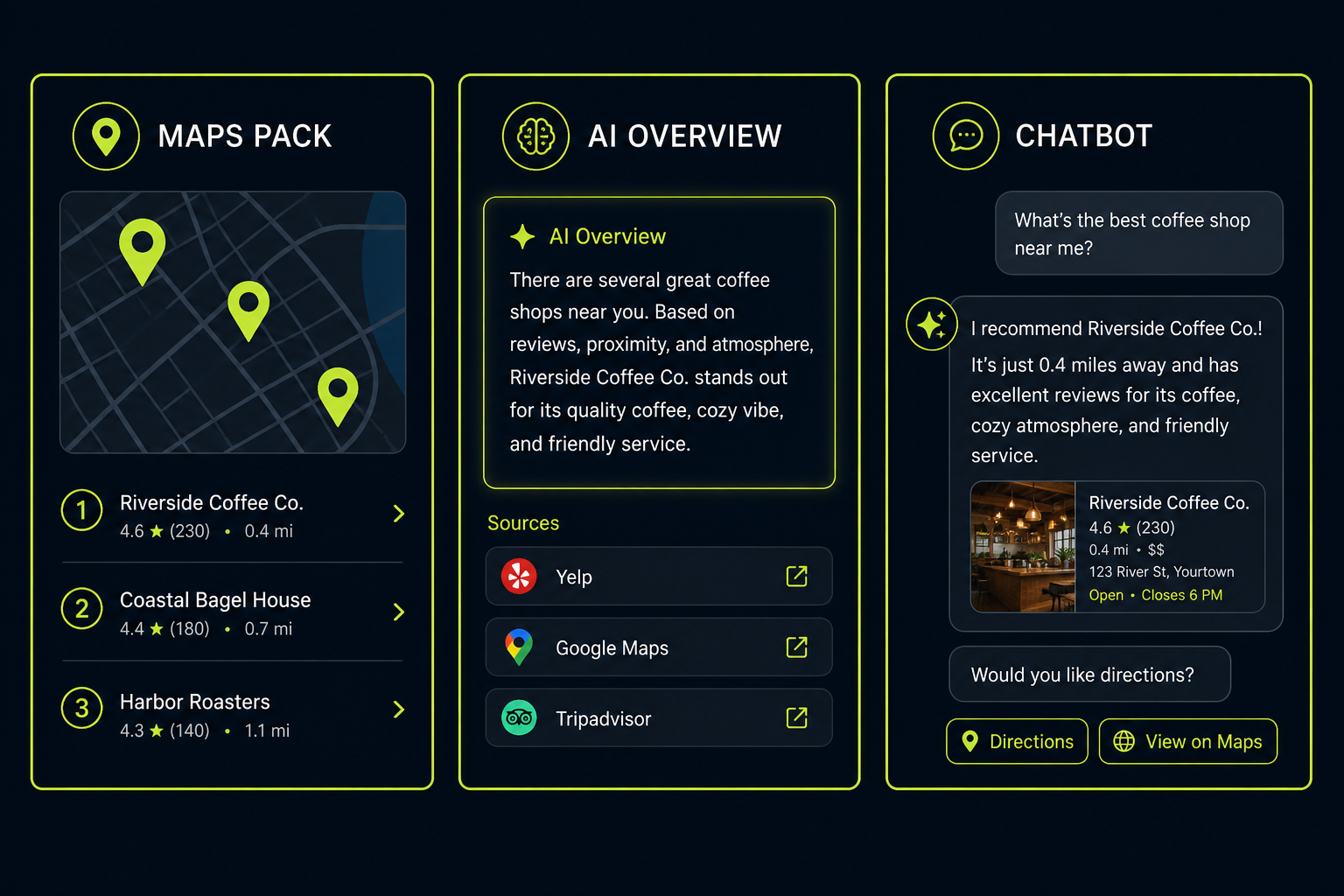
“Who does … near me?” no longer only lands in the three-pack. It lands in an AI answer, sometimes with a source chip, sometimes as a direct recommendation. The lever stays local – the surface changes.
What actually changes locally
Classic local SEO remains the base. What is added is the answer layer:
| Surface | Typical query | Primary data sources | Success metric |
|---|---|---|---|
| Local Pack / Maps | “dentist Bad Oeynhausen” | GBP, reviews, proximity, relevance | pack position, calls, directions |
| Google AI Overviews | “which tax advisor in Münster for ecommerce?” | index + GBP + structured pages | citation, share of answer |
| ChatGPT / Perplexity / Gemini | “who does SEO for trades in OWL?” | Bing/web, Maps/KG, live search | mention, accurate portrayal |
In DACH, AI Overviews fire less often on local queries than in the US – analyses put them at roughly ~10 % of local-intent queries versus ~22 % in the US (OpenLens, 2026). The direction is clear: the share is rising, and on recommendation-heavy phrasing (“best…”, “who is a fit for…”) the AI answer often sits above the pack.
Important: Local Pack strength does not guarantee an AI mention. Studies show only limited overlap between Maps leaders and AI recommendations. You are optimising two related but not identical systems.
Demand picture (DataForSEO, Germany, July 2026)
| Search term | Volume/month | 3-month trend | Intent |
|---|---|---|---|
| google business profile | 12,100 | +21 % | navigational |
| local seo | 1,000 | −38 % | commercial |
| local seo agentur | 590 | – | commercial |
| lokale suchmaschinenoptimierung | 390 | – | commercial |
| local seo freelancer | 390 | – | commercial |
| google maps ranking | 140 | −41 % | commercial |
| local seo beratung | 110 | – | commercial |
Notable: Google Business Profile is growing hard while the umbrella term “local seo” softens. The market is looking for the tool, not the buzzword. In parallel, AI search volume sits at 78 for “local seo” and 57 for “google business profile” – unusually tangible for this topic. The SERP for “local seo” is informational/commercial and dense (SISTRIX, Haufe, agencies), with no AI Overview at measurement time. The content lever: make Local + AI concrete, instead of shipping another generic Local SEO 101.
The foundation: Google Business Profile
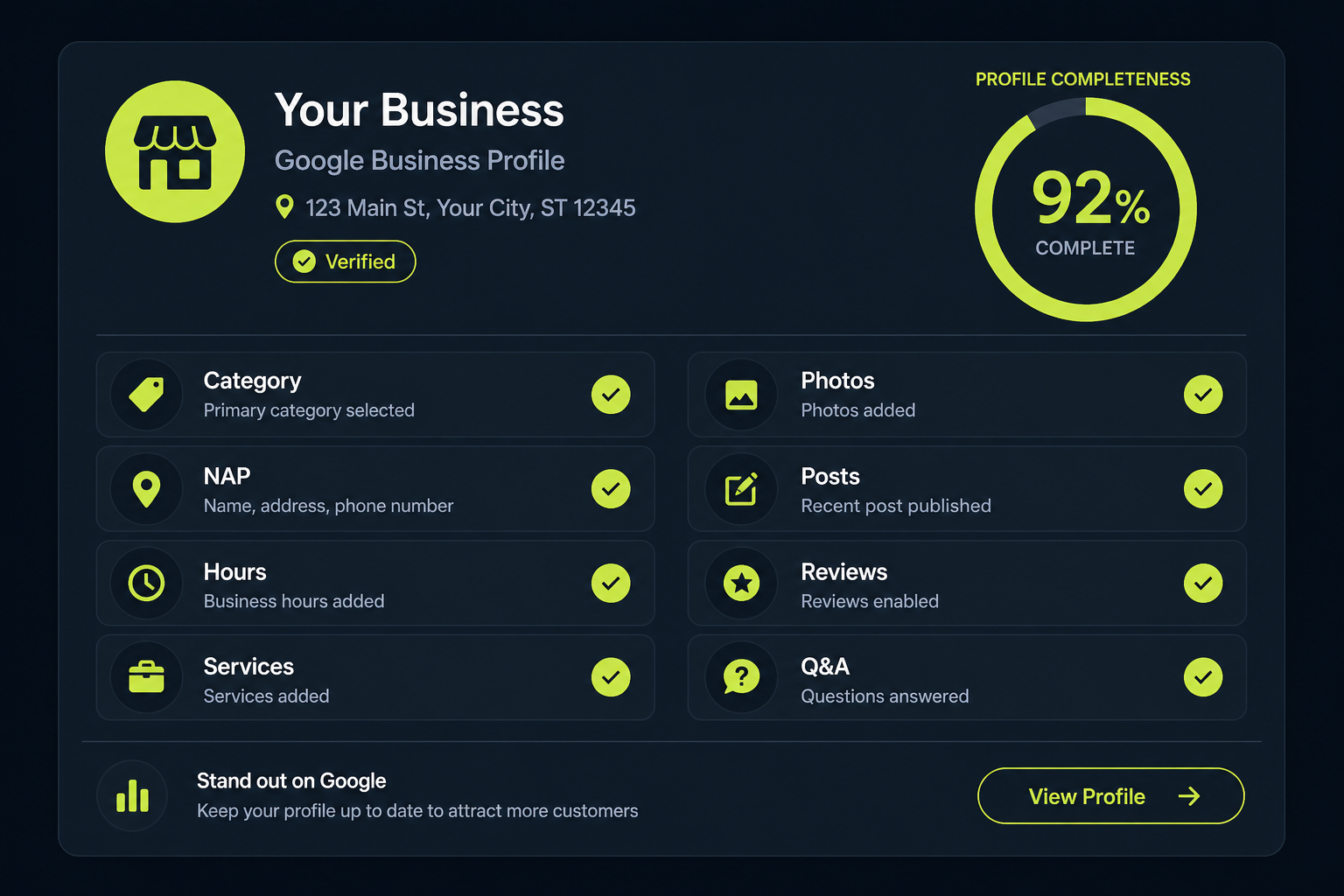
Your GBP is the most important local asset in 2026 – not only for Maps. Gemini leans heavily on Maps/profile data; international analyses show far higher factual accuracy for Gemini against profile fields than for ChatGPT/Perplexity (SOCi 2026: profile information essentially fully correct for Gemini, around 68 % for ChatGPT/Perplexity). Incomplete profiles therefore do not only create weak packs – they create wrong or missing AI answers.
Fields you actually maintain:
- Primary category as specific as possible (not “business”, the narrowest matching category)
- NAP exactly as on the website (spelling, legal form, phone format)
- Services / products with clear names
- Hours including holidays and special hours
- Description and Q&A with real facts, no fluff
- Photos current and service-related
- Posts regularly – freshness is a signal for humans and machines
- Reviews actively managed and answered
A profile with no posts, no new photos and no Q&A for months looks to AI systems like an outdated business card.
The blind spot: Bing Places
A DACH study of 1,500 SMB profiles across five major cities lands an uncomfortable finding: 87 % had no active Bing Places profile – and are therefore effectively hard to find for ChatGPT local recommendations (DTILE Local SEO & GEO Report DACH 2026). Apple Maps was missing for 76 %.
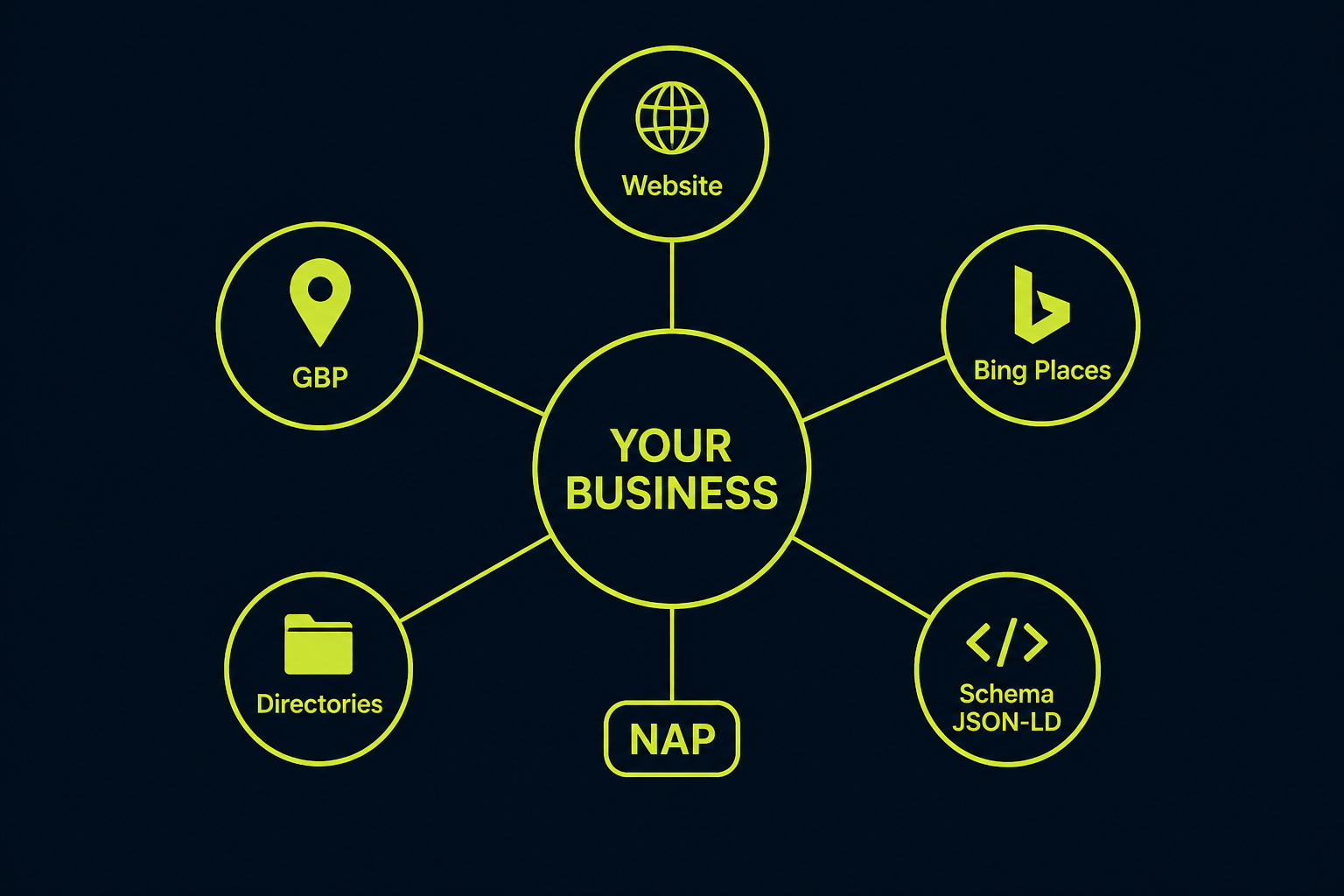
ChatGPT does not primarily pull local signals from Google Maps. If you want to “get found in ChatGPT” and ignore Bing Places, you are optimising past the channel. In parallel: Apple Business Connect for Apple Intelligence / Maps ecosystems.
Minimum setup for the second track:
- Create Bing Places and mirror the same NAP
- Maintain Apple Business Connect
- Treat website and imprint as the canonical source
NAP, entity and schema: so machines recognise you
AI systems do not resolve “brand intuition” – they resolve identities. That needs consistency:
| Signal | Why it matters | Practice |
|---|---|---|
| NAP identity | conflicting spellings weaken trust | website, GBP, Bing, directories identical |
| LocalBusiness schema | machine-readable facts | JSON-LD with specific @type, geo, areaServed, sameAs |
| sameAs | links profiles to one entity | GBP, LinkedIn, industry directories |
| FAQPage | citable Q&A blocks | real customer questions, not fake FAQ |
Schema does not replace good copy. It makes good copy extractable. Specific types (Dentist, Plumber, Attorney, ProfessionalService …) beat generic LocalBusiness.
Content that works locally and in AI answers
Generic service pages without place and without clear criteria lose in both worlds. What works:
- Location + service logic – “SEO for trade businesses in East Westphalia”, not just “SEO”
- Answer-first – clear answer in the opening paragraphs, then depth
- Comparable criteria – for whom, price range, process, duration
- Regional FAQ – “What does … cost in …?”, “How does … work on site?”
- Evidence – reviews, cases, concrete places, service area
AI Overviews and chatbots love decision-ready wording. “We are strong regionally” without facts is useless for both layers.
Prompt examples for local monitoring
Do not only measure “dentist + city”. Measure the questions that trigger recommendations:
| Stage | Example prompt |
|---|---|
| Awareness | “Why doesn’t my trade business rank locally?” |
| Consideration | “What to look for in an SEO agency for trades in OWL?” |
| Decision | “Who does Local SEO in Bad Oeynhausen / Minden / Herford?” |
| Brand | “What does schoettler.io do?” |
| Comparison | “Difference between Local SEO and classic SEO for regional providers” |
Five to ten of these prompts each month beyond Maps intent is enough to see whether you get named – and whether the portrayal is accurate. Method as in Measuring AI visibility: repeat, count frequency, do not celebrate single screenshots.
Technical basics local teams often miss
Without crawlability the best profile only half helps:
- Imprint and contact with consistent NAP, indexable
- No important facts only in GBP – the website must carry the same details
- Mobile and Core Web Vitals – local users and Google both judge speed
- Internal links from homepage and services into location/topic clusters
- robots.txt / crawler policy set on purpose (see Controlling AI crawlers) so retrieval bots can read local pages
A common blind spot: strong GBP data, but the website says “on request” with no place, no radius, no services. Then the web evidence Perplexity and ChatGPT need is missing.
Reviews: content matters more than stars alone
Stars remain a ranking and trust signal. For AI answers, review content matters more: which services are named? which places? which strengths? Ask for concrete experience reports – without fakes, without incentive spam. Reply to reviews (short, fact-based) to increase the density of usable statements on the profile.
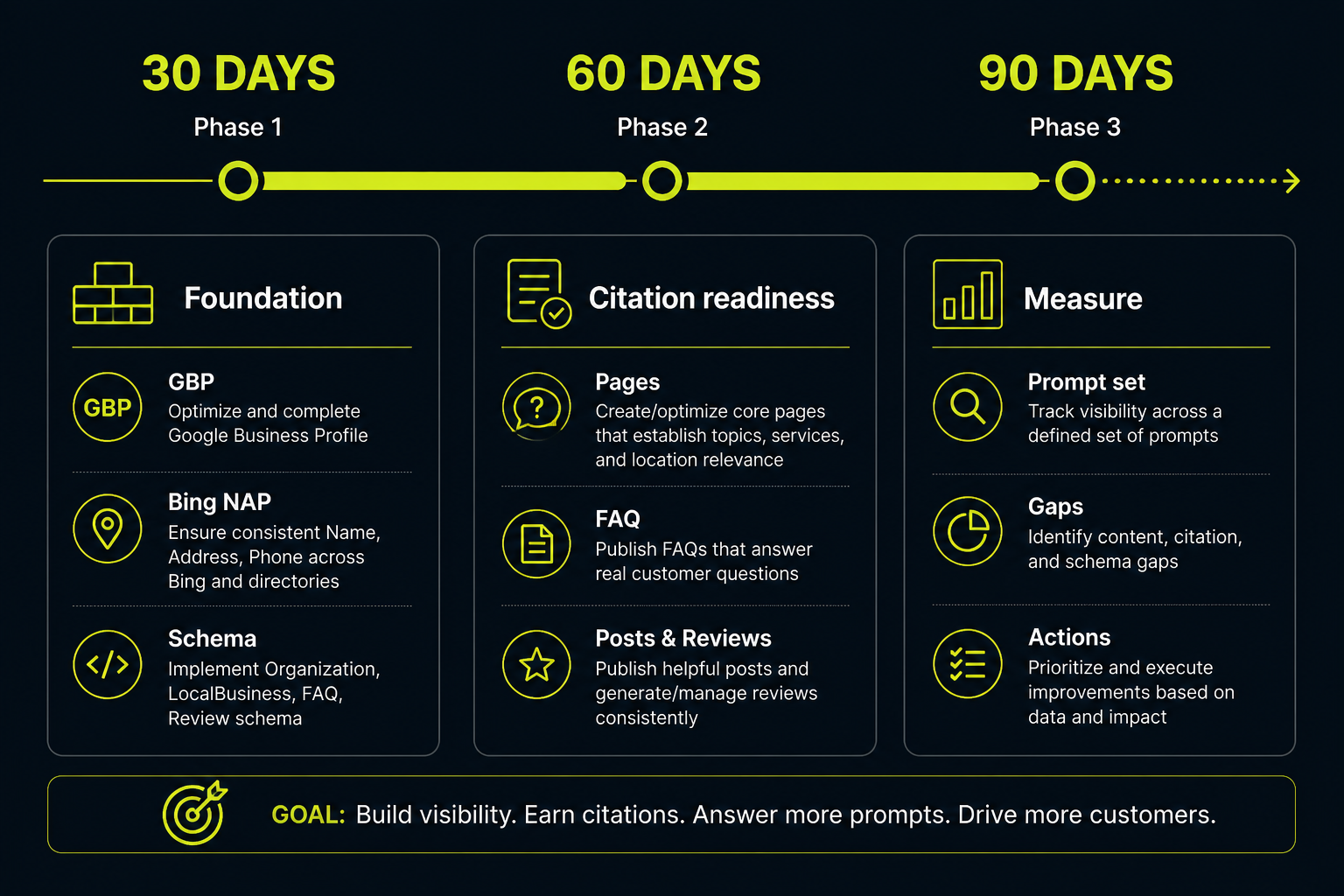
Roadmap: 30 / 60 / 90 days
Days 1–30 – foundation
- GBP audit (completeness, categories, NAP, photos, Q&A)
- Mirror Bing Places + Apple Business Connect
- Clean NAP mismatches in top directories
- LocalBusiness schema on home and contact pages
Days 31–60 – citation readiness
- Sharpen 3–5 core pages answer-first (place + offer + FAQ)
- Weekly GBP posts and Q&A
- Set up a review process
- Define 15–25 local prompt questions (see Measuring AI visibility)
Days 61–90 – measure & refine
- Run the prompt set across AI Overviews, ChatGPT, Gemini, Perplexity
- Note source gaps (which third-party pages get cited?)
- Two actions per month: content or profile – not twenty open threads
Common mistakes
Mistake: Track only Maps and believe you are “done locally”. Better: Watch pack and AI mentions in parallel.
Mistake: Want ChatGPT, ignore Bing Places. Better: Maintain Google and Bing profiles as a pair.
Mistake: Generic about pages without place, offer, radius. Better: Name the entity and service boundaries clearly.
Mistake: Schema without matching visible facts on the page. Better: Markup and HTML must agree.
Mistake: 40 city pages with interchangeable copy. Better: A few strong location/service pages with substance.
Who Local + GEO pays off for most right now
- Trades, clinics, law firms, consultancies with a regional catchment
- Offers that need explanation (“who is a fit for…?”)
- Businesses with a strong pack but falling clicks (Overview / zero-click effect)
- Sites with incomplete profiles – fast lever, often without a relaunch
Less urgent: purely online brands with no location tie. Other GEO levers matter more there.
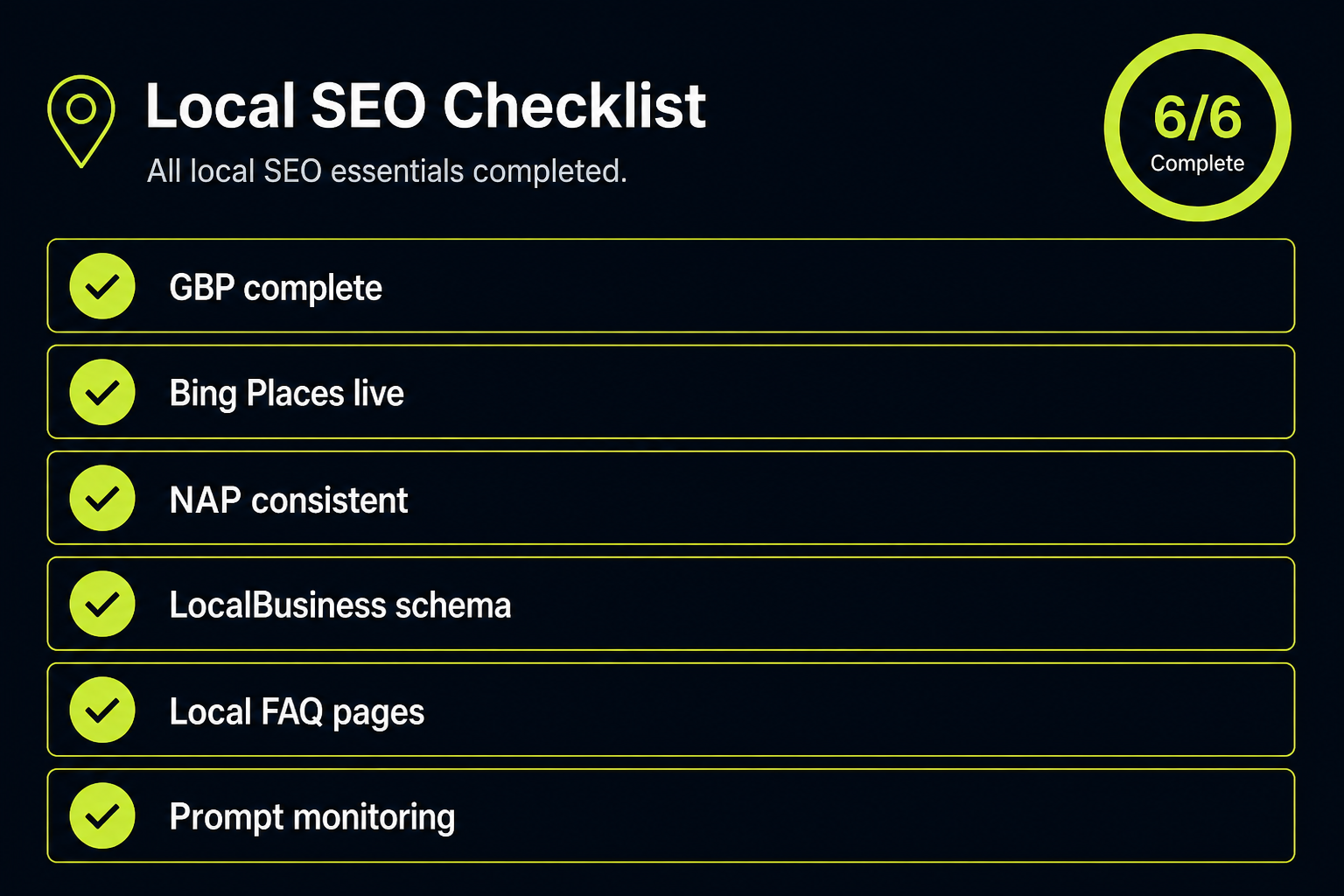
Mini-audit: are you locally AI-ready? (10 minutes)
Walk GBP, website and a prompt set quickly:
- Primary category and NAP on GBP correct and complete?
- Bing Places exists and mirrors the same NAP?
- Website shows place, services and reach clearly (not just “on request”)?
- LocalBusiness schema present and valid?
- At least one page answers a real regional customer question answer-first?
- Have you checked five local prompts in ChatGPT/Gemini/Perplexity in the last 30 days?
0–2 yes: foundation first.
3–4 yes: sharpen and measure.
5–6 yes: iterate – keep the profile fresh, close source gaps.
Conclusion: stay local, add the answer layer
Local SEO is not dying – it gets a second stage. Google Business Profile, NAP and reviews stay mandatory. Bing Places, schema, answer-first pages and a small prompt set decide whether you show up in AI answers or only in the pack. Steer both and you stay visible whether someone opens Maps or asks ChatGPT.
If you want, I’ll review profile, NAP and local prompt visibility in a free intro call. Dig deeper: SEO & Local SEO, AI Search & GEO, plus AI Search & GEO 2026 and Measuring AI visibility.
FAQ on Local SEO and AI
Is a strong Google profile enough for ChatGPT? Usually not. ChatGPT leans on Bing/web signals for local recommendations. Bing Places and consistent web facts matter too.
Do AI Overviews replace the Local Pack? No. On many simple place+category searches the pack stays dominant. On recommendation-heavy questions the AI answer moves up. Steer both.
Do I need a page for every city? Only with real substance. Thin doorway pages hurt. Prefer a few strong location/service combinations.
How do I measure local AI success? With a fixed prompt set (“Who does X in Y?”), monthly across several systems – mention rate and accurate portrayal, not pack rankings alone.