
AI Search & GEO 2026: what really changes – and how you become the cited source
AI Search explained: Google AI Overviews, ChatGPT and Perplexity change visibility. With data, GEO measures and a clear roadmap to get named in AI answers.
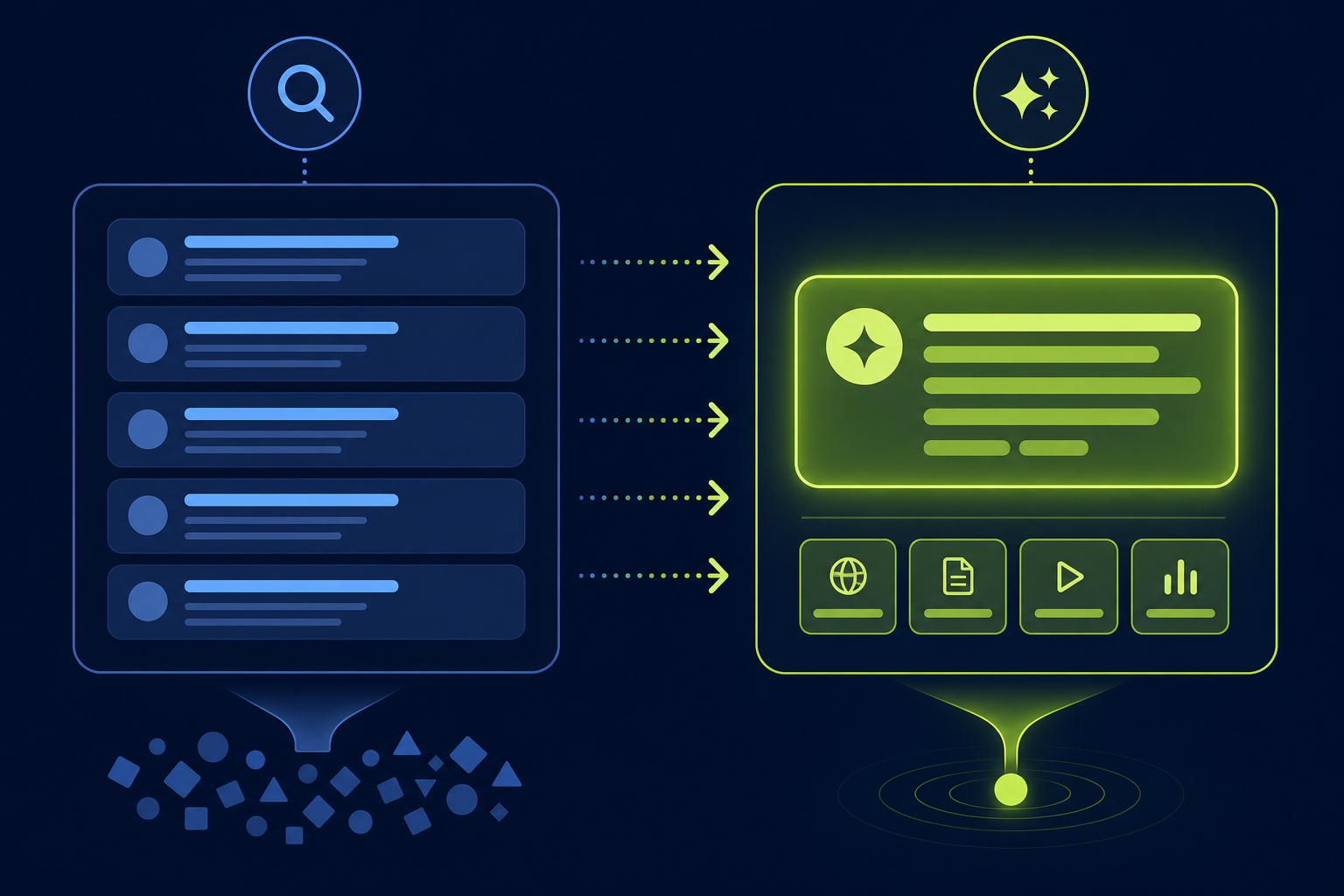
Short answer: AI Search means search systems that no longer deliver a pure link list, but a finished answer – often with sources. GEO (Generative Engine Optimization) is the discipline of preparing content so ChatGPT, Perplexity, Gemini and Google AI Overviews name you as a reliable source. Classic SEO remains the foundation. Anyone who only watches rankings and ignores citation readiness loses visibility where more and more decisions are prepared.
If in 2026 you still think exclusively in “rankings and clicks,” you’re optimizing for yesterday. The question is no longer only: Do I rank? But: Am I named in the answer – and if so, how?

What is AI Search – and why the term is not interchangeable
Under AI Search I group search and research interfaces where a language model formulates the answer instead of only listing URLs. That includes among others:
- Google AI Overviews and increasingly AI Mode
- ChatGPT Search / answers with web grounding
- Perplexity, Gemini, Microsoft Copilot
The common denominator: the user gets a synthesized answer. Clicks to your website are optional – often even unlikely. Visibility then means: mention, citation, source chip, brand naming.
This is not a cosmetic SERP update. It is a currency shift: from click chance to share of answer.
Keyword and demand picture (research status 2026)
For content and topic planning, a clear separation of search terms pays off – even if classic keyword tools still map AI demand incompletely:
| Cluster | Typical searches (DE/EN mix) | Search intent | Content focus |
|---|---|---|---|
| Entry / definition | AI Search, What is AI Search, AI search engines | informational | clear explanation + SEO distinction |
| GEO term | Generative Engine Optimization, GEO SEO, GEO optimization | informational / commercial | definition, methods, practice |
| Platform | Google AI Overviews, ChatGPT SEO, get found in ChatGPT | informational / transactional | platform-specific levers |
| Outcome | get cited in AI answers, AI visibility | commercial | monitoring, measures, cases |
Practical note on keyword choice: The acronym “GEO” alone is semantically noisy in Germany (geography, location, etc.). For SEO and clarity, “Generative Engine Optimization”, “GEO SEO” and “AI Search” work much better than bare “GEO.” Public industry data suggests a low-to-medium but strongly growing global volume for “Generative Engine Optimization” (e.g. Semrush/Entail analyses in the range of a few thousand global monthly searches) – with high strategic relevance because demand behind the term grows faster than classic keyword volume suggests.
The 2026 data picture: why “SEO only” gets risky
Numbers change monthly – the direction is clear.
According to SISTRIX (analysis of 100 million keywords, as of February 2026), AI Overviews appear in Germany on around 20% of keywords. When an Overview sits on top, CTR on position 1 drops from about 27% to 11% – a loss of almost 60% on the most important organic slot. Aggregated, SISTRIX puts the effect at around 265 million lost organic clicks per month in Germany; averaged across all keywords the loss is about 6.6%, with strong industry differences (health and advice portals hit especially hard).
Internationally, analyses from Ahrefs and Similarweb/SparkToro show the same movement: AI Overviews on a growing share of searches, sharply falling CTRs when an AI answer is present, and rising zero-click shares. In parallel, chatbot use as a research entry point grows – especially in B2B.
What follows professionally?
- Traffic is no longer a stable proxy for visibility.
- Informational queries (about 99% of keywords with AI Overviews per Semrush analyses have informational intent) are hit hardest.
- Whoever is missing from the answer loses not only clicks – they lose interpretive authority at the moment of decision.
SEO, AEO, GEO: keep the terms clean
Many articles mash everything into “AI SEO.” For the work you need distinction:
| Discipline | Goal | Typical surface | Success metric |
|---|---|---|---|
| SEO | rankings & organic clicks | classic SERP | position, clicks, conversions |
| AEO | direct answers / snippets / voice | featured snippets, assistants | answer box, voice hits |
| GEO | citation & mention in generated answers | ChatGPT, Perplexity, AI Overviews, Gemini | mentions, citations, share of answer |
GEO does not replace SEO. On the contrary: many generative systems draw on indexed, authoritative web sources. Weak technical foundations, thin content and missing entity clarity hurt in both worlds. GEO builds on SEO – and shifts the focus from keyword density to fact density, structure and citation readiness.
The Princeton work on Generative Engine Optimization (Aggarwal et al., 2023) showed experimentally that targeted content adjustments can increase visibility in generative answers by up to ~40% – while classic keyword stuffing barely helps there. That is not a guarantee for your niche, but a solid signal: different levers work.
How AI Search selects content (without magic)
You don’t need to “outsmart” the model. You need to feed it – with content that is easy and low-risk to adopt.
Typical flow in simplified form:
- Query understanding: What does the person really want to know?
- Retrieval: Which sources are thematically and authoritatively fitting?
- Synthesis: Which passages can be condensed into a coherent answer?
- Attribution: Which sources get named – or silently processed?
Practical consequences:
- Answer-first: The core answer belongs in the first paragraphs / directly under the H2 – not only in the conclusion.
- Chunkability: Short, self-contained blocks (definition, criteria, steps, comparison) extract better than narrative flow without structure.
- Verifiability: Numbers, data, clear statements, tangible examples beat fluff.
- Entity clarity: Who are you? What do you offer? For whom? With which facts? Inconsistency across imprint, about, LinkedIn and website confuses humans and machines.
Generative Engine Optimization in practice
GEO is not a plugin and not a single meta tag. It is a way of working. This is how I implement it.
1. Questions, not only keywords
Keyword tools stay useful – but incomplete for AI Search. Add:
- People Also Ask / related questions
- real customer questions from sales calls and support
- prompt patterns (“What is…”, “Difference between…”, “Is it worth… for…”)
- competitor content that is already being cited
Build a question map per service or topic cluster. Every prioritized question gets a page or a clear section with a citation-ready short answer.
2. Write citation-ready answer blocks
A good GEO block is:
- understandable on its own (even without the rest of the page)
- precise (no soft soap)
- bounded (often 2–5 sentences or a tight list)
- checkable (fact, source, or at least a clear definition)
Weak example: “We offer innovative solutions for modern companies.”
Better example: “GEO (Generative Engine Optimization) optimizes content to be named or cited in AI-generated answers – complementary to classic SEO, which targets rankings and clicks.”
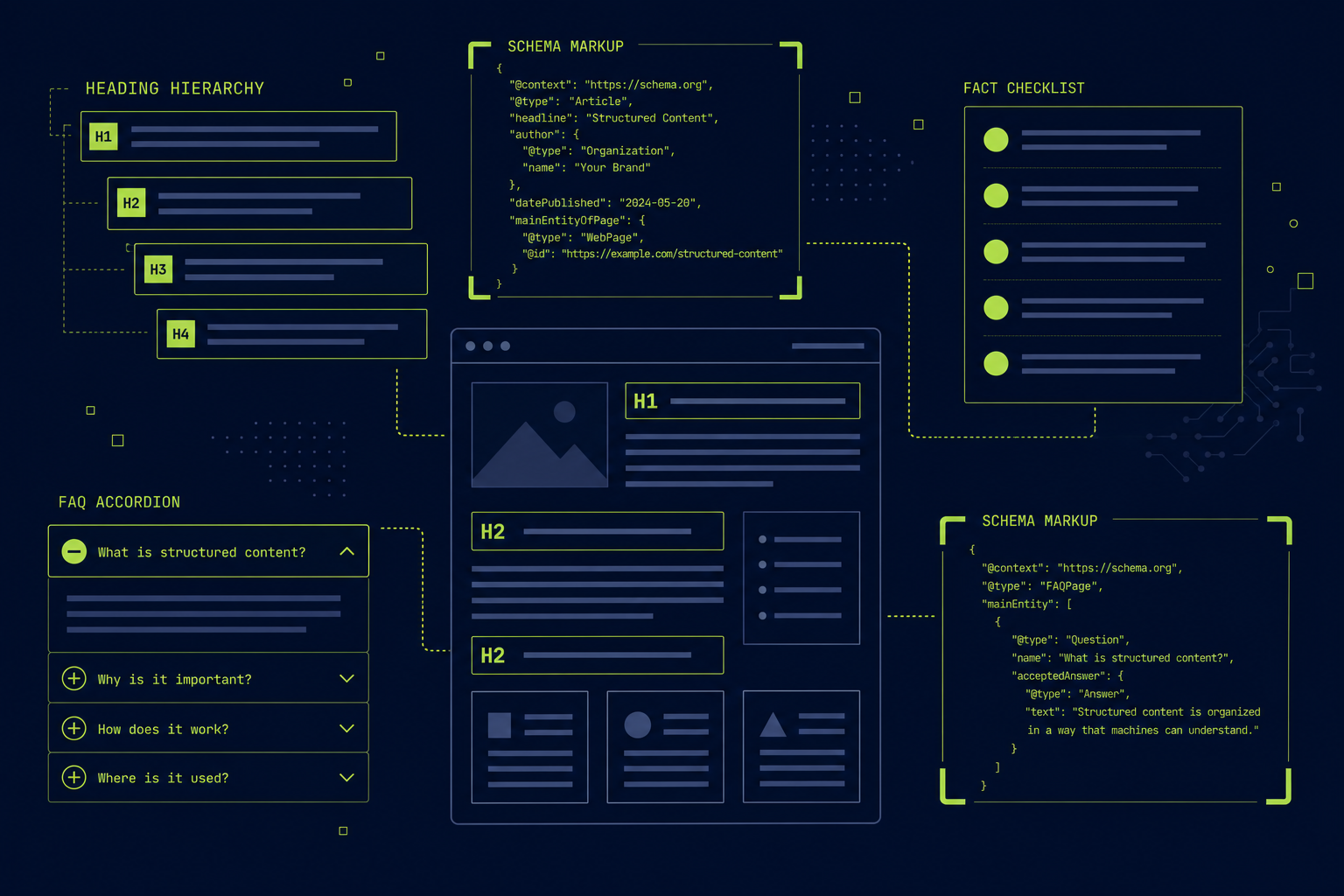
3. Structure and machine readability
Technically, the same building blocks that good SEO has long known help you – applied more consistently:
- clean H1–H3 hierarchy, headings preferably as questions
- FAQ sections with real questions
- tables for comparisons and criteria
- structured data (Organization, Person, FAQPage, Article, Service)
- fast, crawlable pages; no important content behind login or pure client JS
- where useful: clear SameAs references to authoritative profiles
4. Authority outside your domain
AI systems don’t only weigh your website. Mentions on relevant third-party sites, specialist articles, consistent company data and real expertise act as trust signals. GEO without offpage and brand signals stays incomplete – especially in competitive markets.
5. Know platform nuances, don’t overdo them
- Google AI Overviews: tightly linked to the Google index and ranking signals; informational queries especially affected.
- Perplexity: often transparent with sources; good for monitoring.
- ChatGPT: mix of training knowledge and (depending on mode) web search; brand naming and clear entities help.
- Gemini / Copilot: own ecosystems, similar quality principles.
A robust strategy optimizes for the shared optimum: clarity, substance, structure, authority – instead of five separate “hacks” per tool.
What you should not do
- Rewrite everything just because “GEO” is trendy. Often sharpening, FAQ, structure and schema are enough.
- Keyword stuffing as a GEO measure. In generative contexts that tends to be weak to counterproductive.
- Sell or expect guarantees for ChatGPT placements. Work measurably, don’t oracle.
- Only produce blog posts while service pages stay vague. Purchase-adjacent pages need citation-ready clarity first.
- Ignore tracking. Without observation you steer in fog.
Measure: are you named in AI answers?
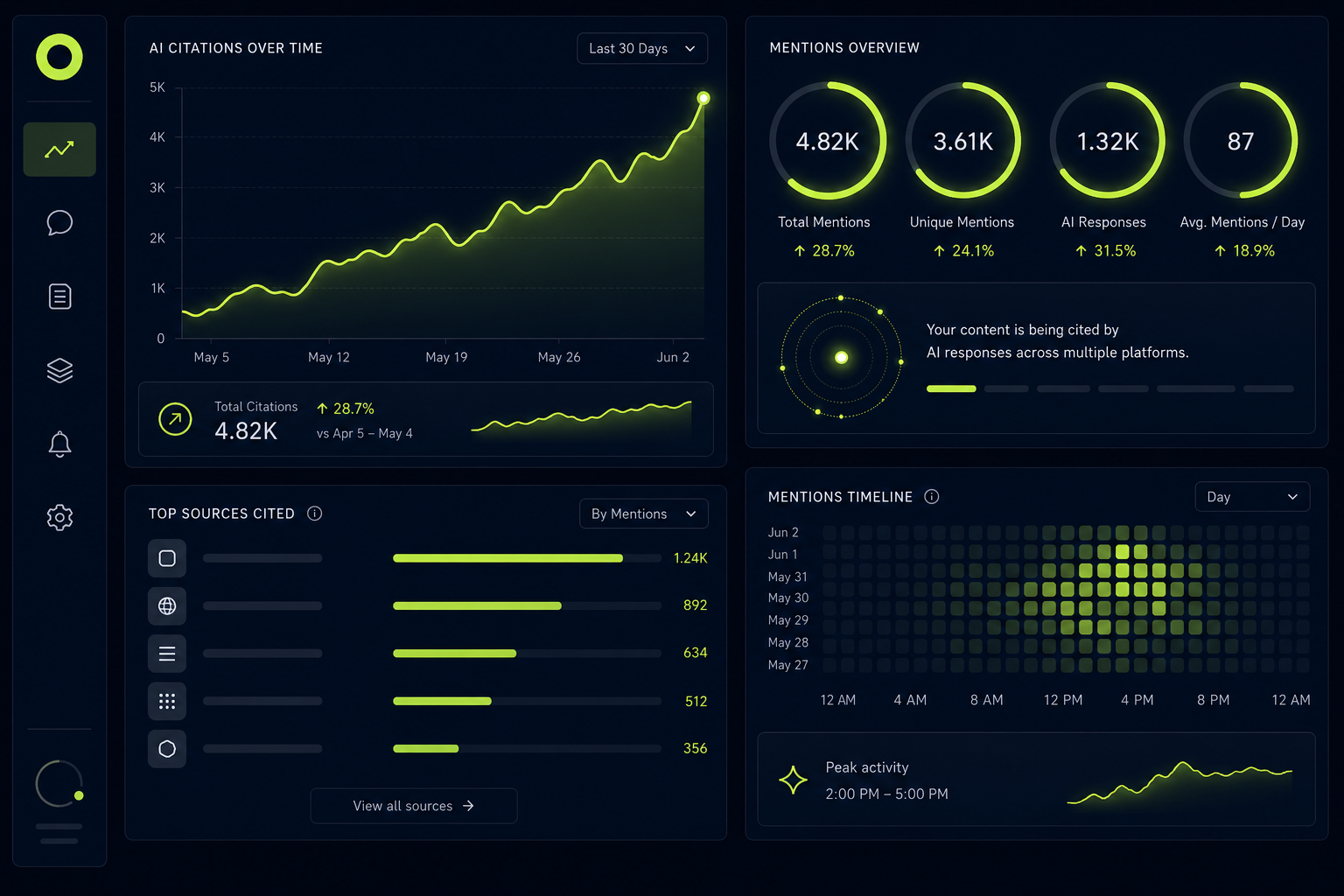
Without measurement, GEO is marketing theater. A sensible stack (pragmatic):
- Define a prompt set – 20–50 real audience questions, queried the same way monthly.
- Manual + tool-assisted tracking – Perplexity/ChatGPT/AI Overviews on a sample basis; plus specialized AI visibility tools where budget allows.
- Read Search Console – impressions stable, clicks gone? Can be a zero-click/Overview effect.
- Document brand and domain mentions in answers (screenshot + date + prompt).
- Derive instead of celebrate – Which pages get pulled? Which are missing? Which statements are fuzzy?
Target metrics that count:
- mention rate on the prompt set
- citation quality (only named vs. linked/cited)
- share of correct representation of your offer
- downstream inquiries / branded search
Roadmap: from zero to solid AI Search visibility
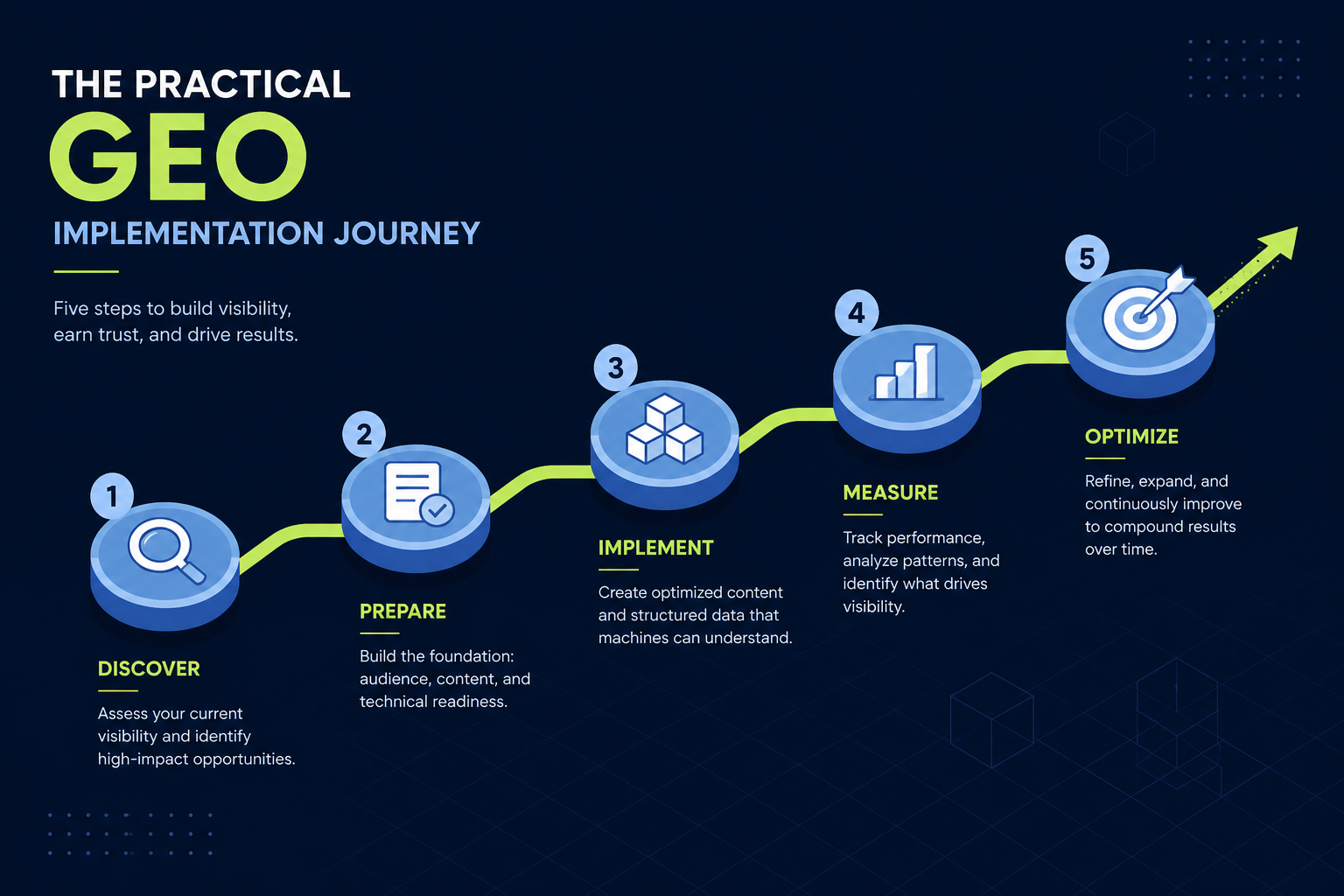
A realistic flow for SMEs and freelancers:
- Audit – website, entities, content gaps, technical brakes, current mentions.
- Question map – prioritized prompts and search intents.
- Foundation – tech, schema, clear about/service pages.
- Sharpen content – answer-first, FAQ, tables, fact density on the most important URLs.
- Strengthen authority – consistent profiles, sensible mentions, make real expertise visible.
- Monitor & iterate – monthly prompt set, adjustments, no big-bang illusion.
You can see first structural improvements in weeks. Stable mentions across multiple systems often take longer – think more in a 1–3 month learning cycle than “next week #1 in ChatGPT.”
Local SEO meets AI Search
For regional providers the overlap is especially interesting. People increasingly ask AI systems the way they used to ask Google: “Who does … in …?”, “Which provider makes sense for … in my region?”
What helps locally:
- Google Business Profile and NAP consistency (name, address, phone) remain mandatory
- service pages with clear location + offer + audience
- regional FAQ (“What does … cost in …?”, “How does … work on site?”)
- reviews and mentions as trust signals – not as fake spam
- no generic “we’re strong regionally” lyric without concrete places, catchment area, specialization
Local SEO and GEO reinforce each other: whoever is cleanly set up locally in classic search and on Maps delivers the same entity graph generative systems draw from.
Content formats that pull especially well in AI Search
Not every format is equally “citation-ready.” In practice these perform:
- Definitions – “What is X?” in 3–5 clear sentences
- Comparison tables – X vs. Y, criteria, for whom what
- Process steps – numbered flows without fluff
- Price/effort ranges – honest spans beat “on request” fog
- Checklists – prepare decisions
- FAQ – real objections, no pseudo-questions
Weaker: pure opinion essays without facts, image copy without substance, tool lists without evaluation criteria.
Mini-audit: are you AI Search ready? (15 minutes)
Go through your most important 5–10 URLs and score yes/no each:
- Is the core statement in the first 150–200 words?
- Is there at least one clearly citable definition or short answer?
- Are H2/H3 readable as topics or questions – not as marketing slogans?
- Does FAQ exist with real customer questions?
- Are offer, audience and location/entity unambiguous?
- Is structured data present and valid?
- Does the text feel verifiable – or only “innovative/holistic/tailored”?
- Is the page fast and crawlable without login?
- Do about, imprint and external profiles match?
- Have you manually checked in the last 30 days whether you’re named on 5 core prompts?
0–3 yes: foundation first.
4–7 yes: sharpen and measure.
8–10 yes: iterate and grow authority.
Typical mistakes (and what instead)
Mistake: “We need a GEO blog.”
Better: Make service and decision pages citation-ready first; blog as depth.
Mistake: Stuff every page with 40 FAQs.
Better: Few real questions with substantial answers.
Mistake: Stare only at ChatGPT.
Better: Spread the prompt set across Google AI Overviews, Perplexity and ChatGPT.
Mistake: Equate visibility with traffic.
Better: Think mentions, correct representation and inquiries in parallel.
Who AI Search & GEO especially pays off for now
- Service providers and consultancies whose customers ask questions first (“What does… cost?”, “What to watch for…?”)
- Explanation-heavy offers that AI likes to summarize
- Local providers who want to appear in regional answers (local + GEO)
- Companies with good content that so far isn’t formulated citation-ready
- Sites with traffic loss despite rankings – classic symptom of AI Overviews / zero-click
Less urgent: purely transactional queries with strong product intent and clear shop SERPs – AI arrives there too, but the lever and drama differ.
Conclusion: visibility in 2026 means playing in the answer
AI Search is not a fad next to SEO. It is the layer where more and more information work happens – in Google, in chatbots, in assistants. Generative Engine Optimization makes your expertise connectable there: clear, structured, verifiable, consistent.
If you want, I’ll check with you in a free intro call whether and where you already appear in AI answers – and which levers move fastest for you. Dig deeper with AI Search & GEO and the foundation SEO & Local SEO.
FAQ on AI Search & GEO
Is GEO the same as SEO?
No. SEO targets rankings and clicks in classic results. GEO targets mention and citation in AI-generated answers. Both are connected; SEO remains the foundation.
Do I have to rewrite everything for AI Search?
Usually not. Often more precise wording, FAQ, structure, schema and clearer service pages are enough. On outdated, unmaintainable sites a clean rebuild is often more efficient than endless patchwork.
Can you guarantee placements in ChatGPT?
Seriously: no. What works: systematically make content citation-ready, measure, refine – and measurably improve the odds.
Are blog posts enough for GEO?
Blogs help with topical depth. Without a clear entity, strong service pages and consistent facts the effect stays limited. GEO is a system, not a single post.