
AI in the content workflow: ship faster without interchangeable copy
A practical guide to content with AI: keyword data, briefings, prompting, quality gates and a workflow that saves time – without generic ChatGPT articles.
Short answer: AI speeds up content massively – but only when research, briefing, editing and approval are orchestrated properly. Anyone who types “Write me a blog post about X” and publishes produces interchangeable copy. Anyone who uses AI as a tool inside a data-driven workflow gains speed and quality: often 35–60% less time per output unit (MaibornWolff, 2026), with a clearer brand voice and better search intent.
The mistake in 2026 isn’t using AI. The mistake is putting AI in place of thinking, planning and checking.
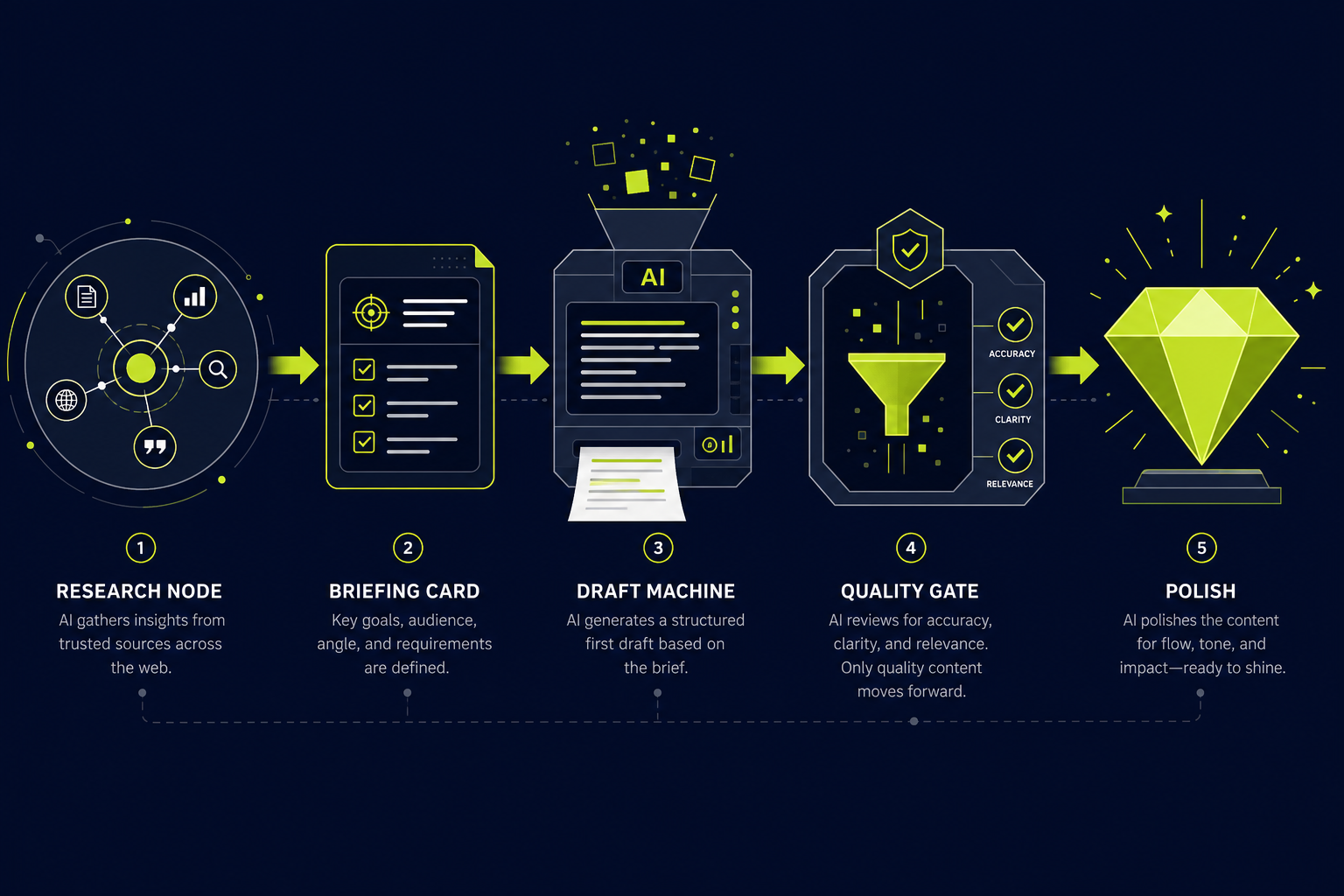
Why most AI copy underperforms
The typical disappointment sounds like this: “We made ten articles with ChatGPT – nothing ranks, nothing converts.” The problem is rarely the model. It’s missing inputs.
Classic weak spots of unfiltered AI content:
- No real keyword and SERP data – the model guesses demand and competition
- Unclear search intent – informational, commercial and transactional get mixed
- No brand voice – tone sounds like “generic internet”
- No first-hand experience – missing examples, numbers, real decisions
- No quality gates – facts, claims and CTAs go unchecked
Google does not “penalize AI” across the board. Google (and increasingly AI Search) rewards content that is helpful, clear and trustworthy. Generic output fails – whether a human or a machine produced it.
For content generation at scale, MaibornWolff puts the realistic effect at 35–60% time savings per output unit – provided you have a prompt stack, brand voice and quality gate. Without review you only increase production volume, not pipeline quality. Separately, Deloitte Digital reports from a marketer survey that GenAI users save 11.4 hours per week on average and free capacity for more strategic work.
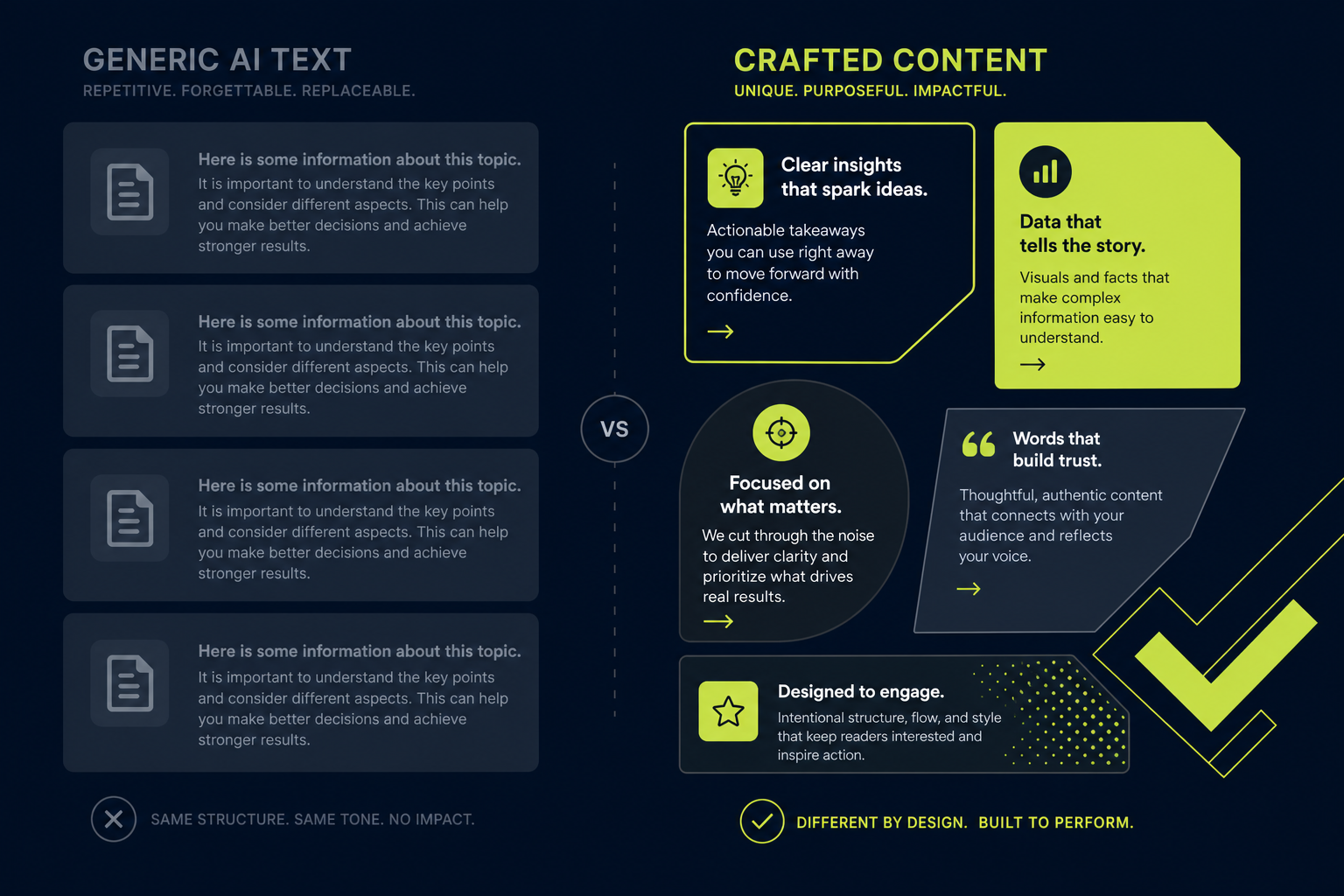
Keyword research first – or the AI writes into the void
Before any prompt starts, you need a topic and keyword decision. Otherwise you optimize eloquence instead of demand.
Keyword clusters for this guide (intent-focused)
| Cluster | Example keywords | Intent | Content type |
|---|---|---|---|
| Core | AI content creation, content with AI, AI in content marketing | informational / commercial | Guide, workflow |
| Tool entry | ChatGPT content, write copy with ChatGPT, SEO copy with AI | informational | How-to + limits |
| Quality | detect AI text, AI content quality, AI editing | informational | Framework, checklists |
| Organization | AI content workflow, content automation, AI editorial calendar | commercial | Process, templates |
| Outcome | create content faster, scale content production | commercial | ROI, setup |
Working rule: Volume alone is not enough. Prioritize keywords where
- search intent matches your offer,
- you can deliver real expertise or concrete examples,
- the SERP is not dominated exclusively by untouchable portals,
- the content can later be citation-ready for AI Search (clear answers, facts, structure).
Tools (Ahrefs, Sistrix, SE Ranking, Keyword Planner) deliver volume and difficulty. AI then helps with question clustering, outlines and variants – not as a replacement for the numbers.
The 6-step workflow that works
This is the process I use in projects and training. It’s deliberately unspectacular – and therefore repeatable.
Step 1: Brief and success criterion
Before anyone says “article,” clarify:
- Who are we writing for? (segment, knowledge level, objection)
- What result should the text trigger? (understand, compare, inquire, share)
- Which URL / cluster are we serving?
- Primary keyword + 3–7 secondary terms
- What must the text not claim?
Without these five points, every model produces mediocrity.
Step 2: Pack the data (SERP + substance)
Collect before the draft:
- top results and their content angles
- People Also Ask questions
- existing own pages (avoid cannibalization)
- internal sources: cases, numbers, FAQs, sales arguments
- compliance limits (promises, prices, legal caveats)
The denser this package, the less the model hallucinates – and the less you have to rescue later.
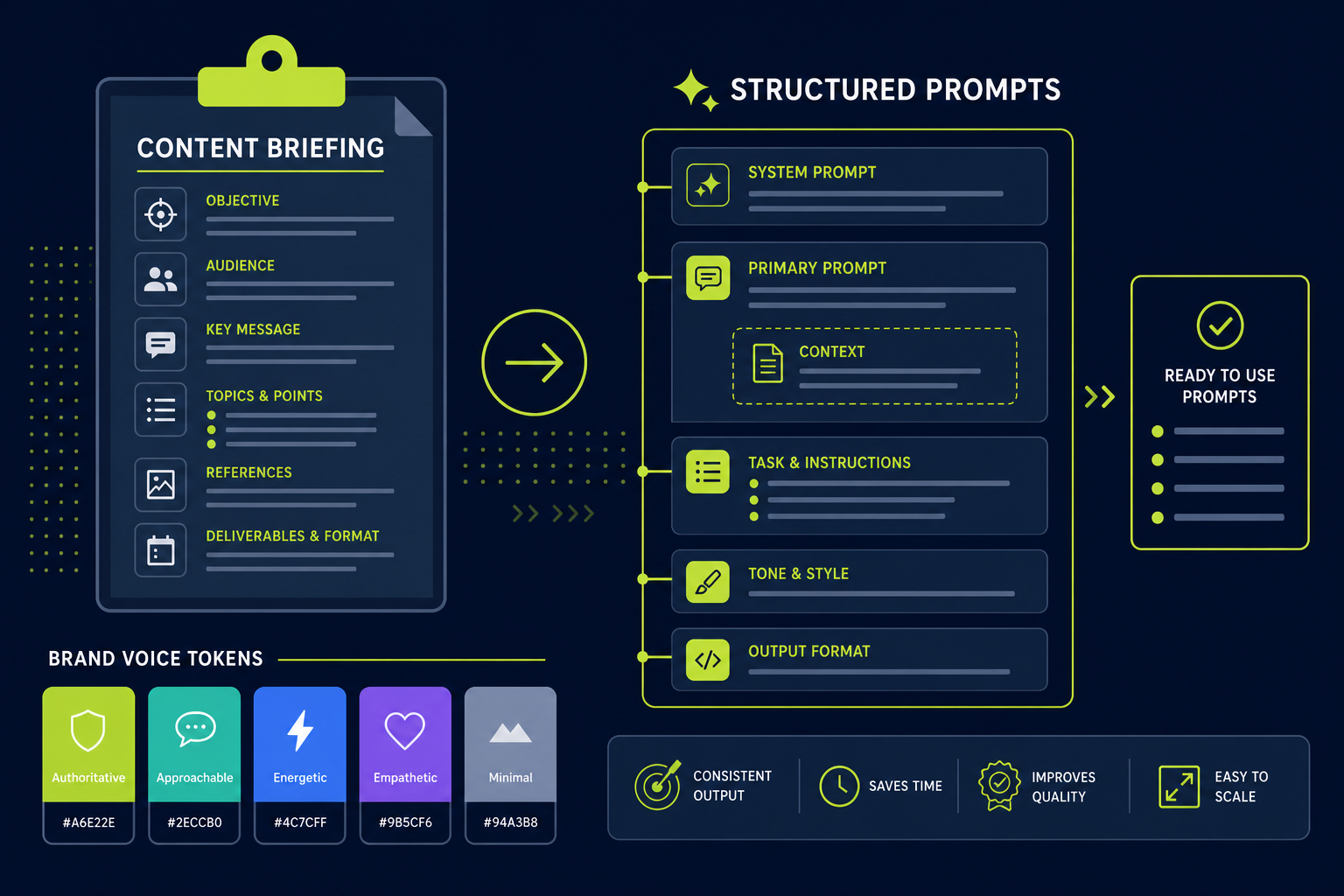
Step 3: Briefing + system prompt instead of “just write…”
A usable briefing contains at least:
- audience and reading level
- primary keyword and required entities
- tone (you/formal, direct/formal, humor yes/no)
- structure brief (H2/H3, FAQ, table, CTA)
- examples and bans (“no phrases like …”)
- desired length and depth level
Prompt principle: Output quality depends largely on instruction quality and the data you provide. “Write an SEO text about AI” is not a briefing – it’s wishful thinking.
Step 4: AI for the rough build, not for truth
Strong use cases:
- outlines and hook variants
- summarizing long sources (then verify)
- counter-arguments and FAQ candidates
- first drafts and rewrites
- meta titles/descriptions in variants
- social snippets from a master piece
Weak use cases without supervision:
- current numbers “from the model’s memory”
- legal and medical claims
- differentiation you cannot prove
- experience reports nobody lived
Step 5: Editing as the quality gate
This is where speed becomes either garbage or advantage.
Quality gate (short):
- Intent: Does the text answer the search in the first paragraphs?
- Facts: Every number, every “always/never,” every comparison checked?
- Differentiation: Is there something only you can say this way?
- Language: Filler gone, claims concrete, paragraphs short?
- SEO/GEO: Keyword placed naturally, clear H2s, FAQ/table where useful, internal links set?
- CTA: One next step – not five.
A model can draft. Responsibility stays human – for me that includes final tone.

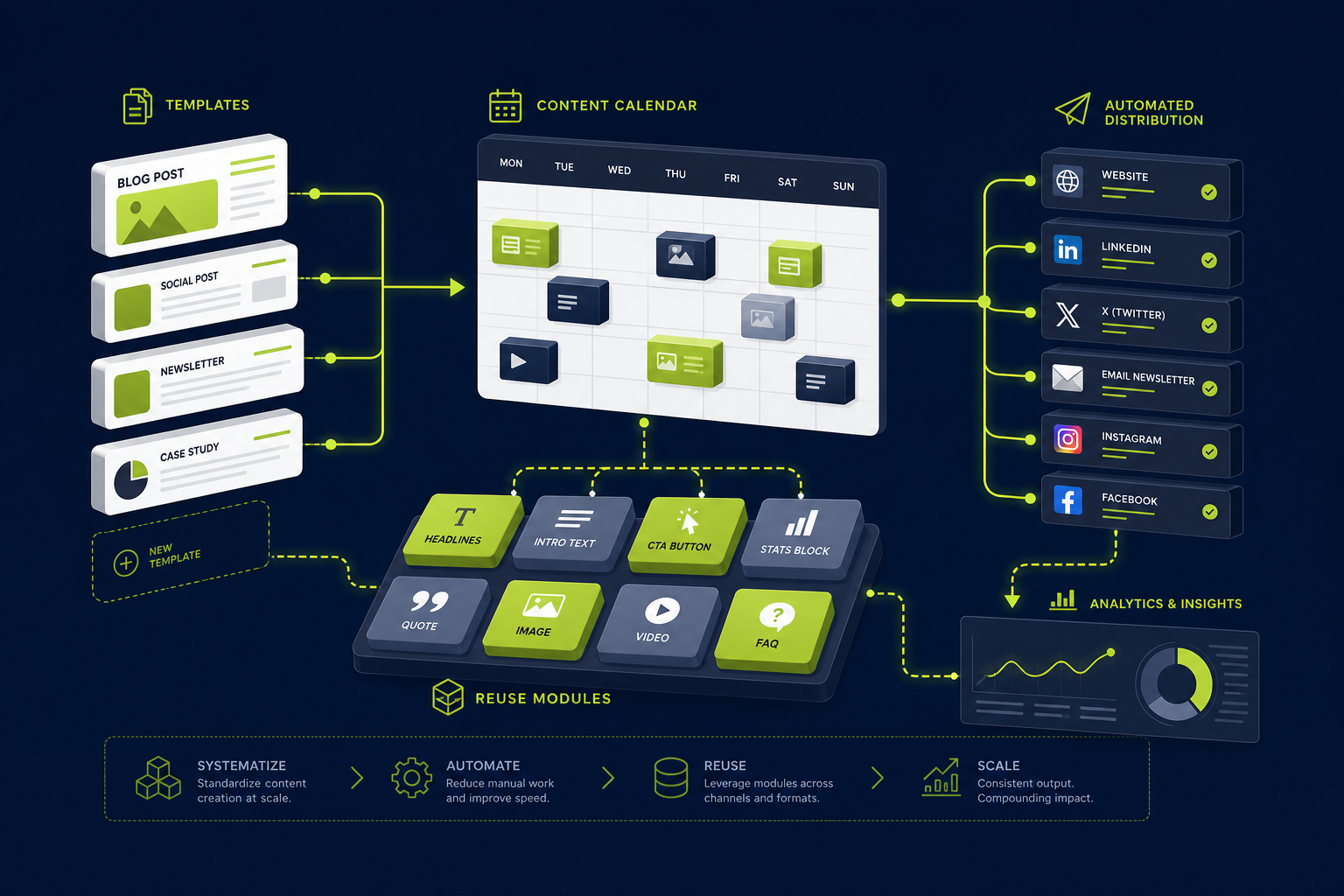
Step 6: Reuse instead of reinventing
A strong master piece feeds:
- LinkedIn/social hooks
- newsletter sections
- FAQ updates on service pages
- short-video scripts
- sales one-pagers
AI is especially strong here: rewriting for channel and length – provided the master source is solid.
What separates “good AI use” from “content spam”
| Weak | Strong | |
|---|---|---|
| Starting point | empty prompt | keyword + SERP + briefing |
| Role of AI | author | sparring partner / draft engine |
| Human | copy-paste | editor, strategist, fact-check |
| Pace | many texts | fewer, sharper assets + distribution |
| SEO | keyword somewhere | intent + structure + internal linking |
| GEO | long text | citation-ready answer blocks + clarity |
| Risk | hallucination live | gate before publish |
| KPI | “articles per week” | inquiries, rankings, mentions, usefulness |
If your team only celebrates output volume, you’re training the wrong metric.
Practical example: from keyword to publish-ready asset
Assume the primary keyword is “SEO copy with AI” (informational/commercial).
- SERP check: Guides dominate → we need workflow + clear differentiation + checklist, not another shallow tool list.
- Question map: Do I need keyword data? Does Google detect AI text? How much editing is required?
- Draft with AI: Outline + rough version based on the briefing.
- Human pass: insert own experience (e.g. typical mistakes from client projects), back up numbers, cut filler.
- GEO pass: short answer up top, FAQ, table SEO vs. blind AI.
- Distribution: 3 hooks, 1 email teaser, internal links to AI content & automation and training.
Result: an asset that can rank and help in conversations – not just “another blog post.”
Organization: how quality stays scalable
For solo and small teams:
- version a prompt library (briefing, outline, rewrite, FAQ prompts)
- keep a brand voice document as fixed system context
- define definition of done before publish (checklist above)
- use topic clusters instead of random topics
- plan half-life: evergreen vs. news – different review cycles
For larger teams additionally:
- separate roles (research / draft / edit / approve)
- approval workflow in the CMS
- style and claim guidelines
- document which models are allowed where (EU AI Act / governance matters more in 2026)
Legal, transparency and images – short and clear
- Responsibility: You are liable for published content, not “the AI.”
- Labeling: In the EU/DE, transparency duties apply depending on context – especially for synthetic media. Pure text content follows different rules than deceptively real person images; still: honest work beats tricks.
- Images without real people: Abstract diagrams, UI visuals and stylized graphics reduce risk and labeling pressure versus photorealistic people – which is why I deliberately use abstract visuals in articles like this.
- Copyright & sources: Don’t copy third-party text unchecked; mark quotes; compensate training-data uncertainty with your own substance.
Prompt building blocks you can copy and adapt
Use this as a scaffold – not as magic. Replace the brackets with real data.
Outline prompt
Create an outline for an English-language guide.
Primary keyword: […]. Secondary: […].
Audience: […], knowledge level: […].
Search intent: [informational/commercial].
Required: answer-first intro, at least 1 table, FAQ with 4 questions, no fluff.
Avoid: “in today’s world,” “innovative,” “holistic,” empty promises.
Use these SERP angles as differentiation: […]
Use these internal facts/examples: […]
Draft prompt
Write the section “[H2]” based on the outline.
Tone: [you, clear, concrete]. Max. 180 words.
Start with the direct answer in 2 sentences.
Then 1 short example or criterion.
No intro like “It is important…”.
Rewrite prompt
Edit the following text:
- cut filler, 2) make vague claims concrete, 3) mark unverified numbers with [FACT?], 4) keep my specialist terms: […]
Text: """ … """
The more real inputs sit in the prompt, the less “internet average” you get back.
Channel rules: one master, many outputs
| Channel | What AI does well | What you must check |
|---|---|---|
| Blog / guide | structure, variants, FAQ draft | depth, E-E-A-T, internal links |
| Service page | benefit wording, objection FAQ | offer clarity, no over-promises |
| hooks, perspective shifts | authenticity, no LinkedIn fluff | |
| Ads | variants for tests | policy, claim hardness, landing-page fit |
| Newsletter | sharpening, subject variants | list relevance, one idea per email |
Rule: master content first, derivatives after. Reverse that and you get inconsistency and double work.
Rough ROI – without consulting slides
Assume a solid article currently costs you 4 hours. With the workflow, effort drops to 2–2.5 hours (research stays, typing shrinks, gate stays).
- 8 articles/month × 1.5–2 h saved = 12–16 hours/month
- At an internal rate of €80–100/h that’s roughly €1,000–1,600 in capacity – or room for better distribution instead of more mediocrity
- Extra lever: more variants for tests (ads/hooks) without doubling the editorial team
ROI turns negative if you spend the gained time on more bad texts instead of sharper assets and reach.
Common objections – and an honest answer
“Then everything will sound the same.”
Only if briefing and editing are missing. Brand voice is a process, not a random model output.
“Google doesn’t want AI text.”
Google wants helpful text. Bad AI text gets dropped the same way bad agency copy from 2014 did.
“Then we don’t need editing anymore.”
Wrong way around: you need more editing per published asset – just less typing on the rough draft.
“We don’t have time for briefings.”
Then you really don’t have time for rewrites on ten mediocre texts. Briefing saves cycles.
“Is a custom GPT / an agent enough?”
As an accelerator: yes. As an autopilot for publish: no – at least not while reputation, SEO and inquiries matter to you.
Conclusion: AI is the turbo switch – not the driver
Content with AI wins when you keep the order: data → briefing → draft → gate → distribution. Then speed becomes a cost advantage and a quality edge – exactly the combination clients notice.
If you want to bring the workflow into your team or set up production with me: free intro call. Related: AI content & automation and practical training & workshops.
FAQ: AI in the content workflow
Which model is “the best” for content?
Secondary to briefing and editing. Claude is often strong on long, nuanced text; ChatGPT is strong in ecosystem and variants. Your process decides.
How much does a human still need to do?
At minimum: strategy, facts, brand voice, approval. Ideally also: own examples and sharp angles no model can pull from the internet.
Can AI replace keyword research?
No. AI can cluster and suggest questions. Search volume, difficulty and SERP reality come from SEO data sources.
How fast do you see results?
Efficiency often immediately. SEO impact still takes time. Bad mass production hurts faster than good individual pieces help – so quality gates before speed escalation.